
Departments In This Story
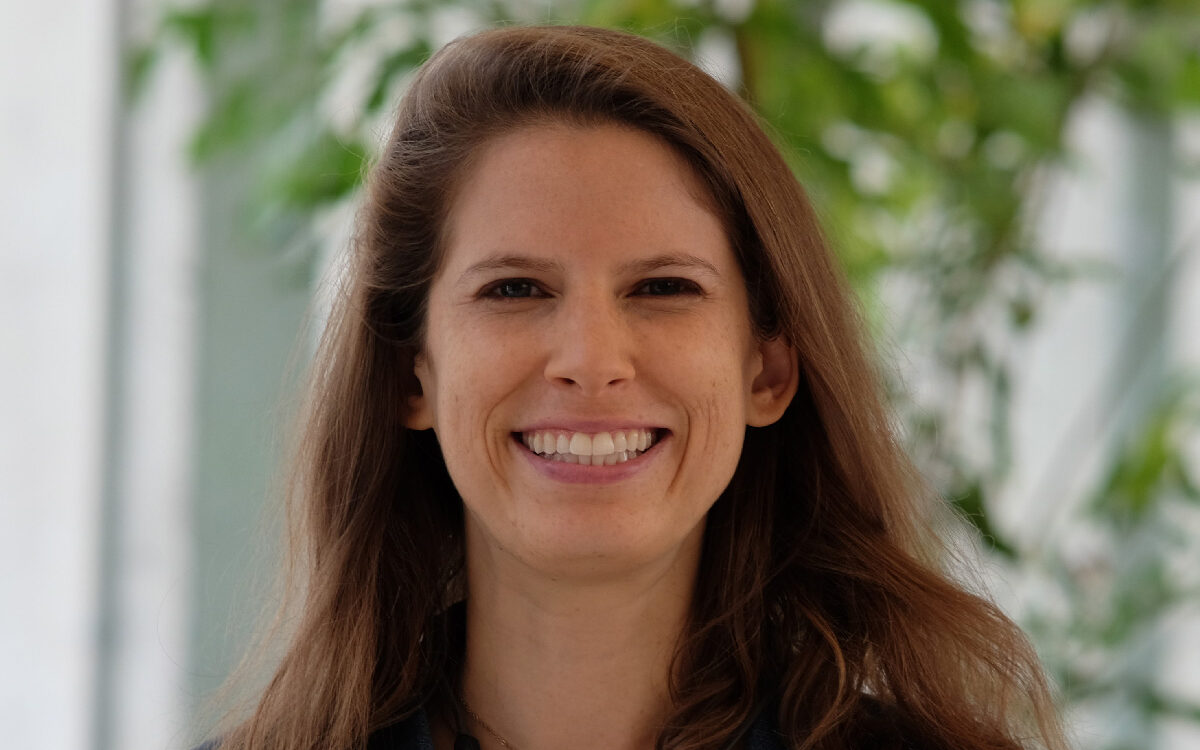
Dana Bullister is a data scientist and Ph.D. student at Northeastern whose research focuses on public policy and social impact. A lifelong Massachusetts resident, she currently lives in Cambridge and enjoys riding her scooter to campus.
Bullister holds a bachelor’s degree in Computer Science from Wellesley and a master’s degree Information Design and Data Visualization (IDDV) from Northeastern. Now, she’s in the last year of her Ph.D. in Interdisciplinary Design and Media.
She’s worked in a variety of roles at different companies, helping them develop tools to streamline their operations and find better ways to visualize data. She formerly served as Chair of the Board of Directors for YWCA Cambridge, and last year, intending to put her expertise to use as a public servant, she ran a campaign for City Council in Cambridge.
Bullister is passionate about civic engagement, streamlining public services and fostering greater transparency in the public sector. She specializes in producing clear visualizations of large data sets, often incorporating animations, 3-D modeling and interactive layouts, which help to make complex, multi-dimensional problems digestible for a general audience.
For this edition of the Scholar Spotlight series, CTM Communications Research Assistant Jackson Diianni spoke with Bullister about the issues that have driven her career in public policy and how she thinks about our ever-evolving media landscape.
This interview has been edited for brevity and clarity.
CTM: You seem to have done a lot of collaborative work and I was wondering how you generally approach collaboration and do you prefer to work by yourself or with a team?
Bullister: That’s a great question. I definitely enjoy being in a team and collaborating. I also think that it can be valuable to be able to work independently for some projects and yet remain really connected to a research lab. So I’m actually doing a little bit of each right now.
Some of my projects involve collaborating with members of the Center for Transformative Media, so I’m working, for example, on a project with Adriana [de Souza e Silva] and Sutanuka Jashu on this project called Mobile AI in Urban Life. In it, we’re basically examining the implications of artificial intelligence as they’re embedded into everyday devices and how it changes human interaction in human spaces. That is very much collaborative, and so I’m really enjoying that.
I’m also working on my own research, which is more individual, I’d say, and it’s looking at how what I term ‘information architecture’ impacts the effectiveness with which a community can understand its own needs.
I’m also working with the Comm Lab – the Communication and Marginalization Lab with Brooke – so I’m in that community as well, even as I’m pursuing my more independent research. But it’s all been really interesting and involves certainly a lot of conversation with a lot of people who are doing related research in other fields.
CTM: Now, I know you ran for Cambridge City Council. What were the major issues that you were running on?
Bullister: I was really inspired to run for that. Some of the major issues for me in my run in Cambridge were definitely affordability – especially for housing – and safe and reliable transportation infrastructure. I was also concerned with equitable representation, advocacy, and influence within the ongoing public conversation, which is quite complementary to much of my academic research.
One aspect of this challenge is that it is actually a really hard problem to understand the prioritized needs of a community, even in situations where everybody in the conversation is working in good faith. Yet, gaining this clarity is essential for balancing needs and effectively allocating collective resources.
So this is an overarching focus of both my research and my political advocacy, and I hope to help bring some of that clarity and insight to more effectively serve local communities.
CTM: Can you tell me, in your own words, what you see as the role of data science in shaping public policy?
Bullister: I think it has a really great and important role. Specifically, I think it forms the foundation of clarity in information that’s needed to even start a conversation.
As people in the computer science field are familiar with, there’s a saying called GIGO, which is “garbage in, garbage out.” You really need high-quality data in order to even have a hope of high-quality decisions. If your data is garbage, your decisions are most likely going to be garbage. So I think that data feeds into public policy, because it really forms the sort of upstream core of what’s necessary to make good decisions.
CTM: I saw that you had created this interactive map in 2020 of hospital infrastructure across the U.S. Can you tell me a little about that project and what led you to create it?
Bullister: This was a project I did as part of my Master’s program, and in this particular visualization, I focused on access to medical care.
If you live very close to a large city such as Boston, you have benefits far beyond just that of accessing jobs. For instance, I think the greater Boston area is the urban area with the fewest fatal automobile accidents. One hypothesis for that is, as people say, if you crash your car in the greater Boston area, you’ll most likely be thrown directly into a hospital waiting room. It just has great proximity to all sorts of facilities. If you live out, away from a big city, however, you don’t have this access or proximity to these hospitals.
Also, hospitals are unfortunately, like many types of companies and organizations, going through this transition where they’re basically merging into bigger but fewer hospitals, which means that people who are farther from a big, urban area have less and less access to the closest one. So I was looking at the scale of this problem: How far away are these hospitals and how much of a disadvantage do people have?
CTM: You’re listed as a “founder” of Project Zen? Can I ask, how did you come to create this and how does it compare and contrast with other productivity apps, like Trello?
Bullister: I am. So, this was one of my, kind of, projects outside of academia, but it’s also relevant to it in certain ways. So I was inspired to make this product, mainly because of my experiences as a product designer and a product manager within industry.
So I worked for a while helping teams to collaborate and make new products and so I’ve used lots of different tools like Trello and Jira and others, and I knew that there had to be a better way to more intuitively and also more easily represent what is going at any given time on a team.
The basis for this app and how it’s more distinctive from other tools is that it allows you to better visualize your workload in, simultaneously, a couple different ways. So it’s easy to – you know, it’s like Trello in that it’s very simple to use, for example, Kanban boards, to track your progress, but you can also easily see within the app itself, what does that actually look like, in terms of the quantity of workload over time. So you can actually look at your various tasks and see, okay, how can I plan my week? How big is my Monday?
So I thought this was much more useful and a much better way to allocate workload. It’s kind of similar in a way to visualizing budget allocation, because there’s always a limited budget. And with a team there’s always a limited amount of time. So it kind of allows you to better optimize your time and to make better products. Yeah, that’s the idea.
CTM: What sorts of organizations would you like to work for in the future? Or with?
Bullister: That’s a great question. One of the reasons that I’m in my current interdisciplinary program is that I have a lot of interdisciplinary experience. I worked in industry, I’ve worked in academia, I’ve been very involved in government and policy-making. And so I genuinely hope that I can continue doing all three in various capacities. I think that it’s perhaps more common for people to spend their entire lives in industry and I definitely could have done that, or your entire life in academia – I probably could do that too. But I think that, if possible, I’d like to pursue opportunities where I can sort of merge the two and perhaps create tools that are useful for both research, but also for real people. So I’ll see how that goes. But that’s my hope.
Related News

For most, El Niño conjures fear. For some, it inspires art.
October 14, 2026
Jesse Hinson to appear in Huntington Theatre production
October 8, 2026
CAMD team gets $900k NSF grant to transform healthcare training
October 8, 2026