
Departments In This Story
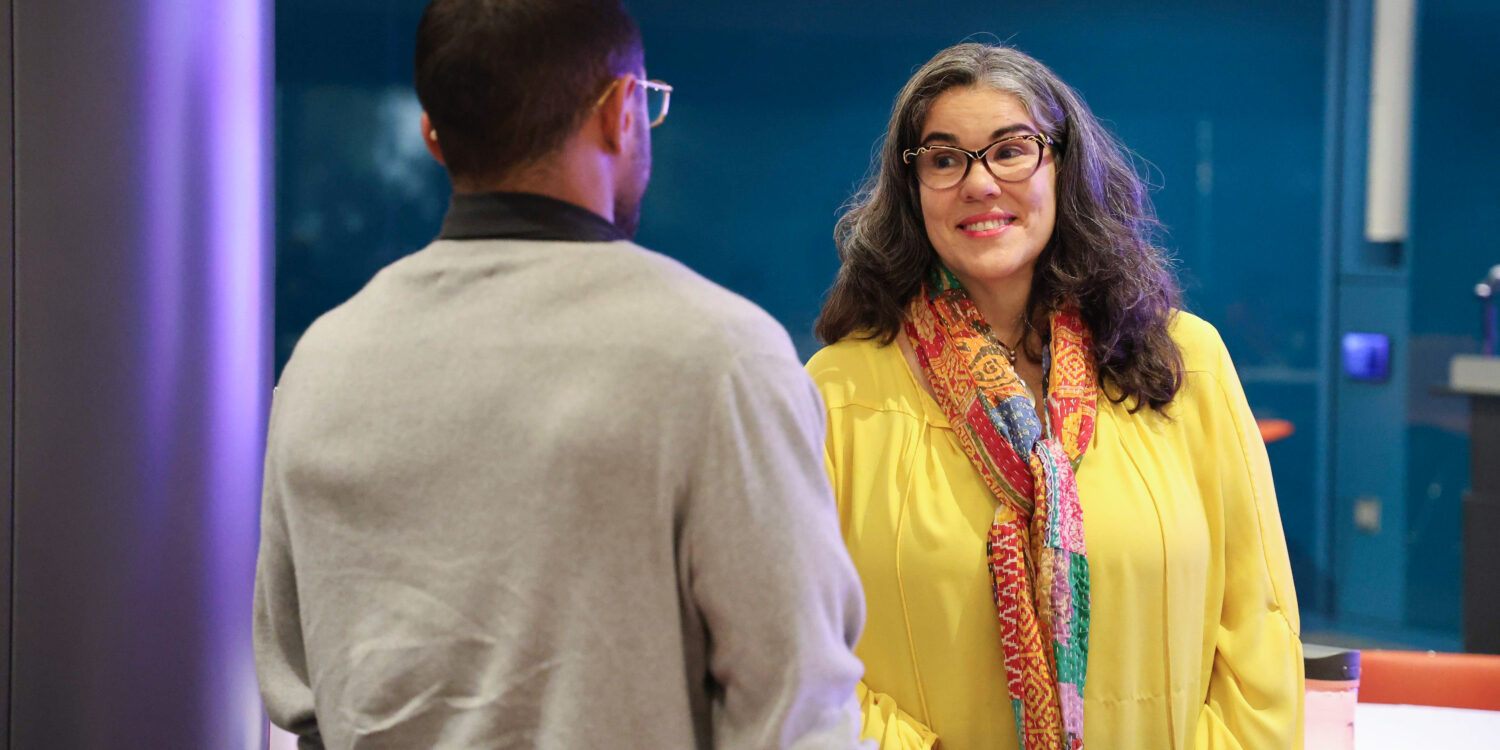
Dr. Maria Elena Villar is something of a jack-of-all-trades. Her research and writing has addressed socio-political issues like gun violence, domestic and sexual violence, climate change, vaccine skepticism, the stigma of mental health treatment and anti-immigrant hate speech, across formats as diverse as peer-reviewed academic journals, book chapters, fotonovelas (graphic stories), radio stories, community theater, and even board games.
As a teacher, she specializes in communications studies and previously taught at Florida International University. She joined Northeastern University in 2022 and maintains roles in the Department of Communications Studies, the Department of Health Science, the Public Engagement with Science Hub (which she co-founded) and the Latinx Student Cultural Center.
Adding to this list of titles, Villar recently joined CTM as an Associate Director. In this edition of Scholar Spotlight, Jackson Diianni spoke with her about why she chose to join the center and what she hopes to accomplish here.
This interview has been edited for brevity and clarity.
CTM: Could you just share a little about your background and how you got into your field?
Villar: My undergraduate degree was in economics, and at that time, interestingly, Hillary Clinton, who was the First Lady, was doing a lot of talking about health economics and kind of how to cover health insurance , so I became interested in health economics and just the problem of public health.
And then, I started working as a financial analyst and I hated it. So, then I went to – I started working as a community health organizer and I really was very passionate about that, until I realized, no, what I want to do is work in the field on public health problems, not analyze public economic data.
So, I did a master’s in public health. And that was a really, really great experience. And then, around that time, it became evident that the – you know, a lot of the main public health problems could really require behavioral interventions, right? So, whether it was infectious diseases – you know, washing hands or foodborne illnesses or sexually-transmitted or things like that – the way to prevent it was to educate people about it. So, I was really interested in health education and that took me to health communication.
When I did a doctorate, I focused on health communication. But ever since my master’s studies, I was working with nonprofits and working with immigrants and Latinos in Miami. So, that’s where my passion is, and to a certain extent, what my expertise and my differentiators – that I have the community connections and I’m able to connect with community folks and kind of understand things from that perspective and help be a bridge between communities and academia. That’s something I’m proud of.
CTM: Tell me about your new role as Associate Director at CTM. What are you most looking forward to?
Villar: Well, after almost four years as chair of the Department of Communication Studies, I’m really excited to have a role where I can really dive into the research and the community-facing work. I’m excited to start programs with students, connecting students with community organizations and making the mission of the center, which is looking at technologies, something that communities can use to better their situations. So, to help give that a bit of a more tangible perspective by building involvement with students and programs.
CTM: What are you hoping to accomplish here?
Villar: I am hoping to help position CTM as the kind of place to go to think about humanistic approaches to technology and community-forward applications of technology. So, we need people to just design the technology, but then we need to listen to the people that are going to be using it in their communities and seeing how they use their own creativity to apply these technologies to achieve the things that they need to achieve.
CTM: How helpful have you found the resources at the Center to be so far? Do you have any favorites?
Villar: I would say that the community – and that includes a lot of the talks and the lunches that the Center convenes, even just as a space to talk. That is something that we don’t have enough of. And I love that it’s a gathering place we can invite students to be a part of, and invite people from other units in the university. So, yeah, it’s just a gathering place –literally and figuratively – a meeting place.
CTM: Can you tell me a little about the work you do with the Latinx Cultural Center?
Villar: That center was important for me when I first got here, to feel grounded and feel that there were people that got me, and that kind of understood my background, and knowing that that place is there for students to do that too, has been great. Plus, they’ve connected me to community organizations, and they’ve helped me just make myself more at home, both as a faculty member and just a resident of the Northeastern community, but even as a researcher, they’ve helped me make connections. They’ve allowed me to host focus groups, you know, and they share information when I ask them for help. So, it’s a wonderful partnership.
CTM: Are there any upcoming research projects you’re currently working on that you can talk about?
Villar: Sure. So, a lot of my past work has been focused on community – participatory research about some sort of issue that’s impacting the community – and then working with community members to co-create solutions – solutions might be too strong a word, but interventions or things that can be done, right? Whether it’s to raise awareness, to educate people about things, to refer people to services, those can reduce stigma about getting services.
So, I’m trying to lean into, how AI can help in that process, right? Because it can certainly make certain things faster, but faster is not always better in terms of building community trust and coming up with truly co-created solutions.
So, that’s something that I’m doing is testing out different AI tools and reflecting on the tradeoffs of the affordances that AI brings and what it takes away. So, what I want to do is, I want to kind of convene students that are interested in that kind of research that’s kind of a humanistic approach to how AI and other technologies are used and looking at them from a community perspective.
CTM: You seem to co-write a lot of your pieces. What is your approach to collaboration like?
Villar: I started my career in public health research, where no one is a single author. That doesn’t exist, really. Studies are done by a team of people, and then the team is on the publication. So I remember when I transitioned into communication studies, people would say, ‘you need a single authored article,’ and I didn’t understand, because nobody does a study all by themselves. There’s always thought partners. So that’s kind of how I was trained as a researcher, and I still believe that, to do a full study, you need many people involved. And I’m a big believer in including students and community members that contribute to the conception and the implementation and data analysis and writing – they should be on the paper. It’s a little bit of disciplinary norms, then, but you never do a project all alone. At least, I don’t.
CTM: What’s something that people might not know about you? Do you have any unique hobbies or areas of interest?
Villar: A hobby that I would like to do more of is dragon boating. I’m part of the Ohana New England team here in Boston, but I started doing dragon boating in Miami, where it was a year-round thing. But when I moved here, I realized it’s seasonal, so just from April to October. And the boats are being put away for the winter.
I really like it, because it’s outdoors, because it’s on the water, because it’s in a team. It sounds a little cliché, but I really kind of – it’s a great illustration of what it means to do things in a team. Like, you have to coordinate, you have to check how other people are doing to figure out what’s expected of you, you have to understand other people’s strengths and weaknesses and what your role is in this particular configuration in this particular moment. So, it’s a little cliché to say that those kinds of team sports teach you about life. But dragon boarding has been a great place, a lovely community. Everywhere you go, the dragon boating community will be kind of open and happy to receive more people.
CTM: Looking forward, are there any subjects you’d like to explore in your research that you haven’t been able to yet?
Villar: I’ve thought about them, but I haven’t done a project on it yet – about how people are sensing these changes in technology are going to change their lives? So particularly AI, of course.
This is such a monumental moment for the role of technology in our daily lives. The internet was that, but the rate of penetration was a lot slower. Not everybody got internet from one day to the next. Not everybody got smartphones from one day to the next.
But since now, a vast majority of people do have smartphones, and, in fact – there’s more people in the world that get internet through the phones than any other way. There’s a lot of people that never had landlines accessible to them, but they have smartphones. So, it’s available to so many people suddenly. And what does that mean in people’s lives and how they use it? It’s something I’d be interested in exploring from the community perspective, from regular people that are not academics or don’t work in tech. What is this doing to their lives and, you know, the good and the bad?
Related News

Explore the Center for Design’s 2025-2026 Year in Review
November 5, 2026
“Media in Motion II” looks at the future of human creativity
November 5, 2026

PhD student Paula Martin Rivero will exhibit work at IEEE VISAP
October 29, 2026