


People In This Story

Departments In This Story
 Hillary Chute, Distinguished Professor of English with a joint appointment in CAMD’s Art + Design department, explores the power and potential of graphic narrative. Given the sharp increase in publication and sales of graphic novels over the past decade, Chute’s work is especially relevant. Through her scholarship and teaching, she encourages her students and others who read her work to see graphic narrative as an expressive and impactful form of storytelling that crosses boundaries and disciplines.
Chute’s first book, through which she established her reputation in the field, is Graphic Women: Life Narrative and Contemporary Comics (Columbia University Press, 2010). In it, she analyzes work by women authors Aline Kominsky-Crumb, Phoebe Gloeckner, Lynda Barry, Marjane Satrapi, and Alison Bechdel. She shines light on these women pioneers who utilized graphic narrative to recount deeply personal stories with humor and poignancy. Before some of these seminal works, women were largely left out of the comics scene. “Bechdel and Satrapi completely altered the graphic novel field,” says Chute. “Both books were bestsellers. Both books created space for graphic memoir in the publishing industry. There’s a ‘before’ and ‘after’ these books. Publishers started to take graphic narratives seriously.” 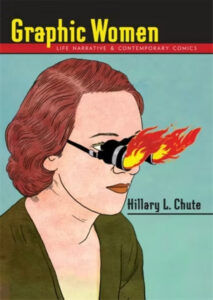 Chute recently honored Satrapi in a piece in The Atlantic, where she explains the impact of her unadorned black and white drawings: “One of the most powerful aspects of the book is the way it bears witness to individual—and collective—experience through the eyes of a child…Persepolis is rendered in flat black and white, with no shading; this stripped-down visual idiom reflects the starkness with which the young girl sees the world; unlike many adults around her, she knows right from wrong.” Chute has known Alison Bechdel for decades, and is excited that CAMD’s Department of Theatre will be staging Fun Home, a musical based on Bechdel’s book, this November.
Much of Chute’s scholarship has explored the impact and enduring relevance of Maus: A Survivor’s Tale, Art Spiegelman’s Pulitzer Prize winning graphic novel. The work tells the story of the author’s father, a Holocaust survivor, and depicts his life leading up to World War II and his time in Auschwitz. Interwoven with this story is a second story about the author’s relationship with his father, which unfolds as he interviews him about his past. MetaMaus: A Look Inside a Modern Classic, Maus (Pantheon, 2011), for which Chute was Associate Editor, provides insight into the creation of Maus through a series of interviews she conducted with Spiegelman.
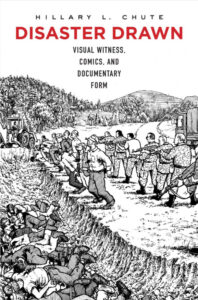 Following this book, she published a solo-authored monograph Disaster Drawn: Visual Witness, Comics, and Documentary (Harvard University Press, 2016), in which she argues that the hand-drawn nature of comics makes them a powerful form of historical witness, with the panels and frames serving as useful tools to segment storylines and incorporate multiple timeframes on a single page. She continued her analysis of Maus with Maus Now: Selected Writing (Pantheon, 2022), an edited collection of writing about Spiegelman’s work. Chute maintains that Maus, “a profoundly antifascist text,” remains incredibly relevant today. It’s a book that humanizes victims of fascism and reminds readers to be vigilant to horrors that are not necessarily confined to the past.
Chute appeals to a broader audience in her book Why Comics? From Underground to Everywhere (Harper, 2017), which was named to the “100 Notable Books of 2018” list selected by the New York Times Book Review. Chute organizes the work around a collection of themes and selects comics within each theme to highlight. Through her analysis, she makes the case that in each of the thematic areas, comics create intellectual and emotional engagement that is different from what is possible through other media. Why Comics? is written for adults, but Chute believes graphic narratives are equally beneficial for young people. 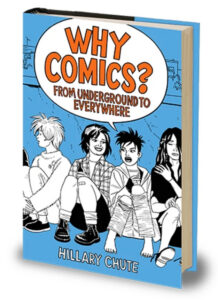 “It’s a special and complex form of literacy,” she says. “People think of words and pictures as redundant, doing the same thing. What you see in comics is that it’s a hybrid form [with] two different tracks. You have to piece together what is happening – the gap between the image and the words…Most people think comics are fast reading. Some are, but in many cases, you’re reading and rereading, piecing together meaning with words and images together.” To shine light on the Boston comics scene and engage young people, Chute and fellow Art + Design professor Tom Starr collaborated to bring the Boston Kids Comic Fest to Northeastern in 2023 and 2024. The event, which drew over 1,000 visitors in its second year, provided visibility to comics creators and included a youth section where teenagers exhibited and sold their own comics.
Chute’s students at Northeastern are often well versed in graphic narrative based on their own reading. Manga, Japanese comic books and graphic novels, are especially popular. These works are read from right to left in the original as well as in translation, and Chute is struck by how quickly students develop fluency in reading in the opposite direction. “Students today teach me a lot…about the contemporary practice of comics reading,” she says. And yet, many shy away from creating their own visual narratives. “So many students are so scared of drawing. It’s not about what you think of as good drawing. It’s about expressivity…We need to reacclimate adults to drawing.”
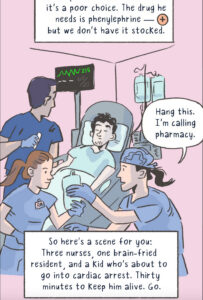
Chute sees many exciting opportunities to broaden the scope of her work and connect to other disciplines. She is fascinated by the genre of comics journalism, perhaps best represented by Joe Sacco and his reporting from Palestine, Bosnia, Gaza, and other conflict zones. She is also diving deep into the relatively new and rapidly developing field of graphic medicine. “Part of what is so interesting,” Chute explains, “is that the field takes inspiration from disability studies, medical humanities, [and] the narrative medicine movement. It puts people together to create work who haven’t been put together before – not just doctors and patients, but medical staff members. It’s about valuing the expertise of a doctor and the perspectives of people who aren’t professional artists but have something to say about health care.” She points to the Boston Globe series Tenderness and Brutality as an exemplar that brings together comics journalism and graphic medicine.
According to 2025 statistics from the Circana Entertainment Knowledge Group, sales of graphic novels are up by 103% since 2018, with manga sales alone up by 187%. Given this dramatic surge in popularity, Chute’s scholarship to date is especially valuable. Even more exciting to contemplate are the interdisciplinary projects she will be exploring in the years to come.
To learn more about Chute’s work, visit https://camd.northeastern.edu/people/hillary-chute/.
Related News
For most, El Niño conjures fear. For some, it inspires art.
October 14, 2026

Jesse Hinson to appear in Huntington Theatre production
October 8, 2026
CAMD team gets $900k NSF grant to transform healthcare training
October 8, 2026