

Departments In This Story
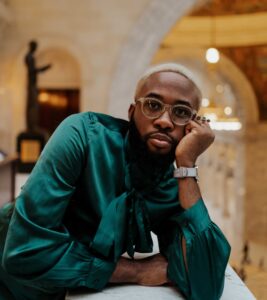
Caleb Okereke is a PhD student in Interdisciplinary Design and Media at Northeastern University whose work sits at the intersection of journalism, platform studies and critical technology research. His research dives into how race operates as a governing technology within AI and digital media systems, tracing connections between contemporary platforms and longer histories of labor, surveillance and representation.
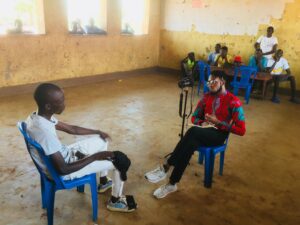
Before entering academia, Okereke worked as a journalist and founded Minority Africa, a publication focused on underreported communities across the continent. His work spans reporting, editing and research, with a consistent focus on how media systems shape the visibility, and invisibility, of marginalized groups.
In this month’s spotlight conversation, conducted by CTM’s Communications Research Assistant Vivica Dsouza, Okereke discussed his transition from journalism to research, the structural incentives shaping media coverage and why he believes alternative platform futures are possible.
This interview has been edited for brevity and clarity.
CTM: You’ve worked across journalism, storytelling and now academic research. What drew you to study media systems after working within them?
Caleb Okereke: I think being in the industry made me more curious about how it actually works. When you’re in a newsroom, you’re focused on the story, what’s happening, what needs to be reported. You’re not really thinking about what makes the newsroom tick or the larger infrastructure around it.
I’ve been fortunate to see the newsroom from two perspectives, as a reporter and also as someone responsible for building and editing a publication. That founder role made me more curious about the broader ecosystem. Research helps me see that scaffolding more clearly, especially around media, representation and how certain groups are covered.
CTM: You founded Minority Africa to center underreported voices. What gaps in mainstream media pushed you to build your own platform?
CO: A big gap is misrepresentation and what I’d call problematic representation of minorities. Media platforms are often incentivized to report on minority groups in ways that drive virality, even if that means reinforcing harmful narratives.
There’s also a lack of cultural context and awareness in how stories are told. Even when intentions are good, the storytelling can still be insensitive or reductive. That combination, incentives for harmful coverage and a lack of understanding, is what made it feel necessary to build something different.
CTM: Your research examines how race operates as a governing technology within AI and digital media systems. How do you see this shaping how stories are produced and circulated?
CO: I’m interested in race as a technology, not just race in technology. That means looking at how race itself functions as a structuring logic within systems.
My argument is that technological systems are racial from the onset, and by extension, colonial. These systems and racial structures develop together. For example, content moderation work is often outsourced to places like India, Kenya or Ghana, where workers are exposed to disturbing material so others can experience a sanitized internet.
I’m also looking at how AI systems operate, for instance, how large language models might make editorial decisions, like selecting images, and what racial assumptions show up in that process.
CTM: Where do you see the biggest disconnect between how platforms amplify narratives and how communities actually experience those issues?
CO: The biggest disconnect is that platforms are not designed for our well-being or flourishing. Their algorithms are structured around different priorities.
Because of that, it’s almost impossible for them to accurately reflect lived experiences. We’ve seen this in real-world contexts — for example, during conflicts where platforms were accused of amplifying harmful content despite warnings from people on the ground.
I think we’ve also accepted current platforms as the only possible model, but that’s not true. There have been different forms of social media before, and there can be alternatives. We need to start thinking beyond the systems we have now
CTM: As platforms increasingly mediate journalism, who do you think holds the most power today – journalists, platforms, or audiences?
CO: Right now, platforms hold the most power. That’s very clear in how changes to platform features can immediately disrupt journalism.
But I don’t think that has to be the final state. We still have collective power. Hopelessness isn’t useful, we need to think about how people can act together and imagine alternatives.
Part of my work is about expanding what people think is possible. If we can imagine different systems, we can start to move toward them.
CTM: As both a journalist and researcher, what changes do you hope to see in how media represents marginalized communities in the next five years?
CO: I’ve seen some incremental change, people are more aware of bias now, but it’s not enough.
A lot of harmful representation comes from the pressure to compete for attention in an algorithm-driven environment. That often leads to scapegoating minority groups for virality.
I’d like to see media organizations think more creatively about how they operate within that environment without relying on those tactics. There are other models. For example, at Minority Africa, we don’t rely on ads or paywalls, and we’ve found alternative ways to distribute stories.
I’d also like to see a shift away from rigid ideas of objectivity. Journalism is inherently shaped by subjective choices, and being more honest about that could lead to better, more responsible storytelling. By this I mean the choice of what to cover, who to interview, what to air or not to air—that is all, by nature, a subjective decision. Now, we have objective methods to do this really subjective work but it is not by any means an entirely objective process. Frameworks like relational journalism, or solidarity journalism—which have been championed by journalists and scholars alike—show us what it might look like to do journalism on the side of the “oppressed.”
CTM: That’s great. Is there anything else you’d like to add about your work or how you think about AI and media?
CO: I think we need a more nuanced approach to AI. It’s not useful to say we should completely avoid it.
At the same time, we have to acknowledge the realities behind these systems, including the labor and harm that make them possible. Especially for marginalized communities, disengaging entirely isn’t a good strategy.
What I advocate for is critical engagement. You don’t have to use these systems fully, but you should understand how they work. That awareness is necessary if we want to critique them, adapt to them or push for change.
Related News

CAMD faculty make world’s top 2% scientists list
October 20, 2026

Music Department makes top music business schools list
October 20, 2026

Jose Luis Garcia del Castillo y Lopez wins teaching award
October 15, 2026