

People In This Story
Departments In This Story

Victor Zappi, Associate Professor in the Department of Music, is an engineer and musician whose work focuses on the design and use of new interfaces for musical expression. The CAMD Faculty Affairs team sat down with him for an interview on October 13, 2026.
How long have you been at CAMD?
I joined CAMD in 2019, so seven years at this point.
Where are you from originally, and are there things you especially love about your place of origin?
I come from Italy, born and raised there, and I studied there as well. So I have a very strong understanding not just of Italian culture, but also Italian education. In general, I think there is a strong sense of community in many Italian cities and neighborhoods that left a strong imprint on me. And it’s the same community I found in CAMD, by the way. I think human connections is the thing that I like the most.
How and when did you decide that you wanted to be an academic?
When I started my PhD, I was not necessarily interested in academia. I was interested in research. I was seeing myself probably working in an R&D department of some company that does something related to either music or some other creative or creative adjacent domain. My experience at university was not amazing, so I was a little bit disappointed. I worked in a research lab for a couple of years and while I liked it, I didn’t see any future there for me and I had the same feeling coming from the other laboratories in the same department. So maybe the industry would be a better host. But then during my PhD, I had a chance to travel a lot and came here to Massachusetts for a conference in 2010. It was a IEEE VR conference and at the time I was working on VR and music and sound. I visited a couple of places here in Massachusetts and they were different, and I fell in love with this different environment here in the United States. I felt a lot of synergy between students and faculty. I saw these very dedicated research labs with amazing projects, very creative, and I really enjoyed this idea of the campus and sharing spaces beyond work. And so I decided to really go toward that direction. At the time, I didn’t have much teaching experience, and I did my best to catch up, and I also discovered that I really enjoyed teaching. It was basically the perfect combination – working on the research that is always fueled by students that are young and different, and then teaching them, which was very fulfilling.
Your work focuses on the design and usage of new interfaces for musical expression. What do you mean by interfaces for musical expression?
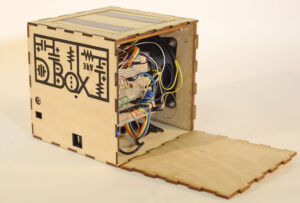
It’s a replacement for the word “instrument.” Interfaces may be part of a sound installation, an audio-visual installation, an interactive performance. You’re not just focusing on an instrument per se that can be used by a performer on stage; you’re talking about an apparatus that involves the interaction with sound and music that can be deployed in more diverse scenarios.
How are Northeastern and/or CAMD different from other places where you have worked or studied?
Very different. I have an engineering background. It was 100% engineering until my PhD. So that part of my studies was very different, as you can imagine. During my PhD, I started working with music and technology together. Nonetheless, the institution was very much oriented toward the technical side of things. So I was part of a very small group that had interest in music as a form of expression. Music was a means of expression for me, and I wanted to study how it works and how technology can supercharge it, in a sense. After my PhD, I had a few postdoc positions that were kind of similar. There was more music because I was definitely closing in toward music and music technology as an actual field, not just a combination of two different fields. So I targeted places where music was really the main focus and the technologies were the applications, but nonetheless, most of them felt like engineering + music.
CAMD is very different. CAMD is Arts with a Capital A. Everyone has a strong background in music, theater, design, games – everything that is expressive, everything that made my life cheerful when I was in engineering school. Students and faculty, of course have a very technical background. But what really strikes me is the artistic side of the people around me, everyone from freshmen to senior colleagues, and at the Dean’s Office too. Everyone really knows what they’re talking about when talking about humans – how we experience ourselves and connect with others and use art to do that. That is the main difference, and I think the quality of life really benefits from that. And we are very far also from a conservatory attitude, at least from a musical perspective. We have very clear guidelines on what students should go through to have a strong musical background when they get a degree. But I think it’s more fluid. There is more freedom of choice, a wider interpretation of music and anything that is connected to it. And I assume this happens also in all the other departments and schools inside CAMD. I assume that architecture is not the same in an architecture school that is not part of a college of arts, media, and design. And I think the game design group is very different than a game design group inside of computer science.
And since my whole trajectory was very much technically driven, I feel I have to catch up with most of the people around me, especially with students, which feels weird but good in a sense. I learn from students a lot of things that also feed back into my teaching. You get to know better what people that don’t necessarily come from engineering or computer science can make with music and technologies. So why not, right? Why not incorporate these different perspectives and see if my classes can benefit? They may become more inclusive and also more in line with the expectations that the students – or I wouldn’t say expectations, honestly, I think it’s more about the potential. There is a part of the potential the students have that would really resonate with different approaches compared to the approaches to teaching that I explored before coming here. So this is an important feedback loop that really impacted how I lead classes and also design classes.
Can you provide some examples of recent projects?
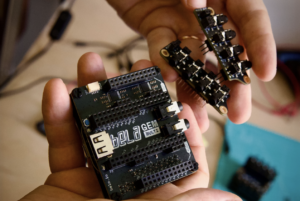
Lately I’ve been working on a lot of technologies that are very deep into the stack – not instruments or interfaces that people use as end products, but more like technologies that can be used to design end products or research products. There’s a lot of programming involved when we design new interfaces for musical expression. There’s a lot of hardware involved – digital hardware, analog hardware. So I’m working on some platforms that combine digital and analog electronics that are designed so that it is possible to build instruments and interfaces that are particularly good for musical expression. What does it mean? It means that the systems must be very responsive. When you interact with them, you want to hear the result immediately and in a consistent way, which is basically how acoustic musical instruments work. There’s no delay between you plucking a string and hearing the sound. Well, many technologies for the development of interfaces for musical expression have this issue of latency. There is a concept of degrees of freedom. So you can pluck a string in 1,000 different ways. It’s the same string and the same pitch, but it will sound completely different every time. This is very important for a musical instrument. It allows for mastery, virtuosity, and also personal expression. This is very difficult to accomplish unless the digital and analog technologies that we use – the electronics – are conducive to this kind of nuanced interaction. And now there is AI involved. Now we want our instruments to have some kind of artificial intelligence element in them, and this is very computationally heavy. So how do we combine these requirements with the previous requirements that we have always studied and explored for the design of new interfaces for musical expression? So I’m working at that level, hoping that the outcome will be something that people will use in the next generation of AI-powered, responsive, nuanced musical instruments or interfaces for musical expression. And I come from a previous experience during my postdoctoral research that did the same with another generation of technologies. So I just started last year to rethink this and say OK, it’s time to update this. It’s time to research if we can improve the current state-of-the-art given the new requirements, especially coming from the AI side of things.
When you’re creating an interface incorporating AI, what does that look like for an average person using it? What will that person be doing?
Literally any musical instrument is an interface. It’s something that you use to make music. So it can go from a keyboard that maybe knows what you’re doing. It keeps track of what you’re doing and has some kind of intelligence embedded into it that doesn’t just keep track of what you’re doing, but may add something to what you’re doing in line with your intent. Or something that is more esoteric, something that tracks your body position and makes sound depending on what kind of movements you want to do. And there may be some kind of AI system in there that does a very complicated mapping between your movements and the timbre of the sound that is being generated on the fly. Timbre is such a complicated concept that is very difficult to map. The parameters of synthesis that may generate different timbres are arbitrary in a sense. But using artificial intelligence, we can really work with a higher dimensionality input and output situation in which the body movements are scanned and analyzed in detail. It’s really something that AI learns as the interaction evolves.
And what do you think is the benefit to the human performer?
Well, nothing wrong with how we perform music right now, absolutely, but it’s an opportunity to do something different, to explore a different type of music making, music that hasn’t been thought before. The process of making music has a strong impact on the outcome, regardless of what genre you’re targeting. It’s like playing with someone else, maybe. That’s a good example that we can relate to. It’s not something that replaces you. It’s really about working with a system that understands what you’re doing and adds something to it, gives you some opportunity to modify what you’re doing. It’s kind of a feedback loop between two entities. But the entity is inside of an instrument or inside of a system rather than outside of it. There are some situations in which the AI is given another instrument, but what I’m really interested in is the embedded AI context in which the AI is using – co-using – your own instrument. I’d like to design a system that can be used like that, that can be used to develop instruments that have this capability. We want to design the first technology that supports that. How will people use it? How will it change the usual music making process and workflows? Will it be positive? Will it be negative? Will the music be the same? These are all open questions, and there are other groups that work on these research questions. Embedding the AI inside of an instrument is something that is still very, very hard to see. So that is our open research question.
Right now we’re really starting from an engineering perspective. We are working on chips. We identified a family of computer chips that fit all the characteristics to support the design of new musical interfaces that embed AI, but they are not meant for that, which means that the way they work right now is not in line with what we need. So we are reworking the low-level software that runs on these chips, and that gives us access to the different resources on the chips so that for musical researchers it will be easier to use them and connect other parts into them and build an instrument around them. It’s really about programming and creating even new versions of the operating systems that run on these chips.
What is a project you are especially proud of?
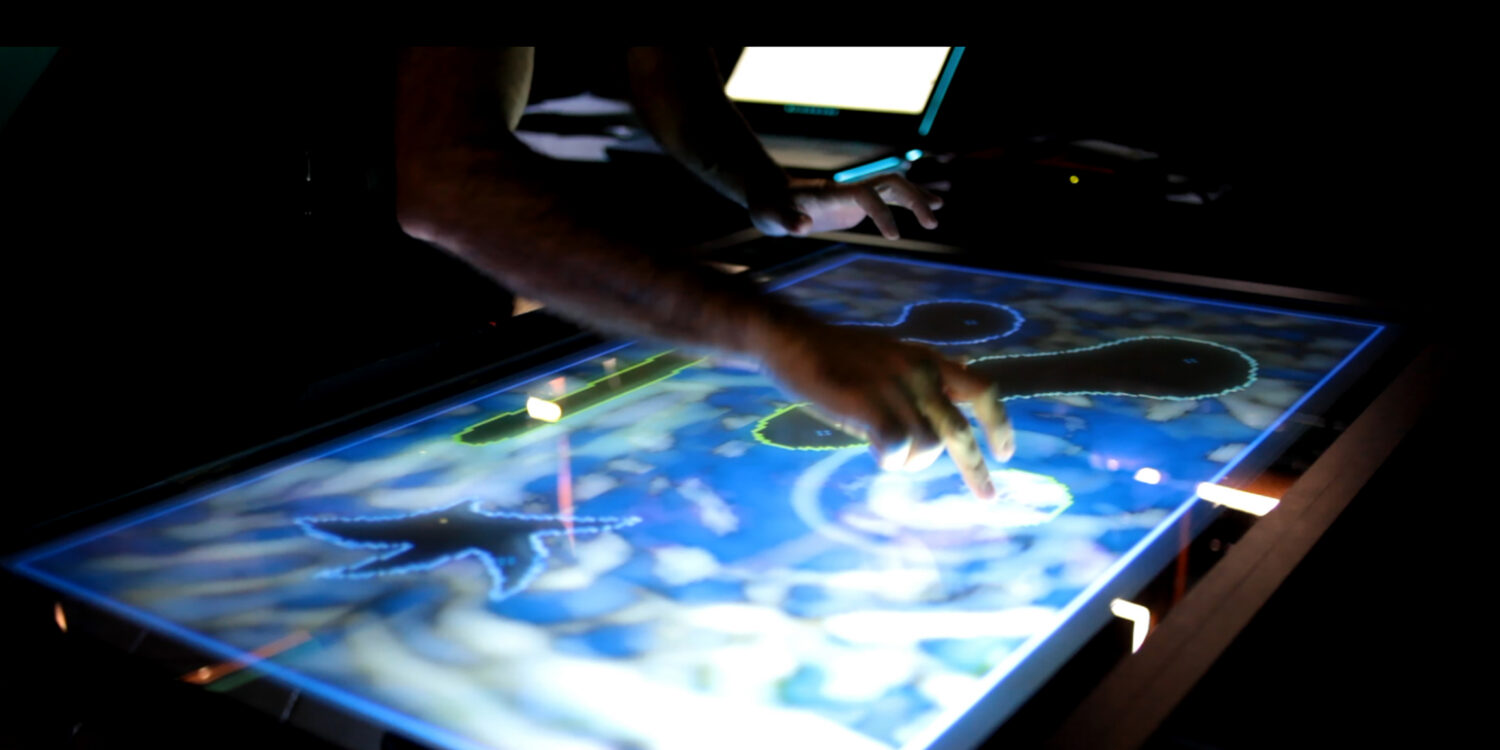
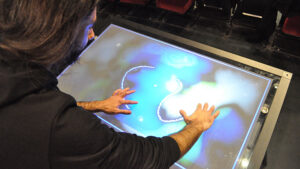
There is a project that I really enjoyed carrying out for a few years during one of my last postdocs. The artifact is a new musical instrument, a new interface for musical expression that is really an instrument, something that you bring on stage and you make music with. It’s the underlying technology that is really awesome. It’s a tabletop instrument, and when you touch it, you inject sound into a simulated space. These sound waves bounce around, and they create resonances. It’s like playing God with sound, in a sense, on a 2D plane. I want sound here, I want this space a little smaller, I want more reverberation here, I want to move the sound somewhere else. It’s called the Hyper Drumhead because it started as a simulation of a flat drumhead. And then using a technology called physical modeling, I was able to introduce a lot of parameters to change the size of this resonance space, the material, where to inject sound, what kind of sound to inject into there. It was a fully-fledged instrument with visual feedback in the sense that you could see the sound that is propagating in the simulation and you could place your hand to stop it exactly when you want. It has been used by a few musicians. So I was able not only to develop the technology, which meant that the contribution was scientific in a sense, because this technology was new at the time, but also was able to encapsulate it into an interface that supports musical expression, which is not a given. We have many technologies that are very interesting, but no one was ever able to turn them into something that can be used on stage. And then I got some feedback by some musicians. I modified some of the details of this instrument. And in 2018, I won a big prize at the Guthman Musical Competition which is held every year at Georgia Tech. It’s one of the most prestigious new instrument competitions, and it was an amazing experience.
There are different disciplines represented in your work. How does this interdisciplinarity impact how you teach, and how do students respond to this interdisciplinary approach?
I teach in the music technology program where most students are combined majors with music and something else. In most cases, the something else is engineering, computer science, or physics – domains far from music. So the expectation of students is to find common ground between these very far apart disciplines. I think it’s very easy for us music technologists to find this common ground because we have a very technical approach, but the end point is musical. So we design and develop software and hardware, we use engineering and computer science approaches, but this software and hardware has to support music making. So it’s really easy to describe or teach students why they have to learn a specific technique, why they have to understand a specific concept, even if it’s computer science related engineering. Typically, we do the opposite. We say we need to allow for a specific sound or musical feature. So we need to go back to the software and modify so that it allows you to do that. So the interdisciplinarity is basically that music is the entry point of any technical discourse that we do, and any technical discourse is unraveled through music and sound. And when I say music, I mean sound that has to come out from the speakers, but also how we perceive it. Sometimes there is a big gap between the two. So human beings are also a lens through which we learn how to design technology and use technology, which is another way for students to feel a little bit closer to the engineering side of things. This doesn’t happen that often in engineering classes and computer science classes. There is a lot of abstraction because abstraction is optimized. It’s easier to apply, but you lose the thread. You don’t understand what you’re doing anymore. We do the opposite here. We lock on music, humans, the human experience, and we translate that into the more technical workflows and theories and stuff that is otherwise pretty abstract. So I think our students understand why abstraction is useful because they come from the human side of things.
Are there additional disciplines beyond engineering that you’re interested in collaborating with?
Absolutely. Everything that revolves around psychology and human cognition, psychoacoustics, which means how we perceive and describe our experience of music and sound. Those are fields that are deeply embedded in our music technology program. Some of us are experts in that field plus music. Some of us are just using that field as one of the many expressions of interdisciplinarity in the music technology program. I’m part of the second group. I don’t have a degree in psychology, but as I said earlier, the human side is so important to understanding technology. And the more time I spend in CAMD, the more I learn about this stuff, the more I connect with people that bring in these different human disciplines, and the more I want to embed them into research and teaching. Beyond that, more on the technical side, right now I’m interested in quantum computing because it’s a field that has connections with music technology.
Related News
CAMD faculty make world’s top 2% scientists list
October 20, 2026
Music Department makes top music business schools list
October 20, 2026

Jose Luis Garcia del Castillo y Lopez wins teaching award
October 15, 2026