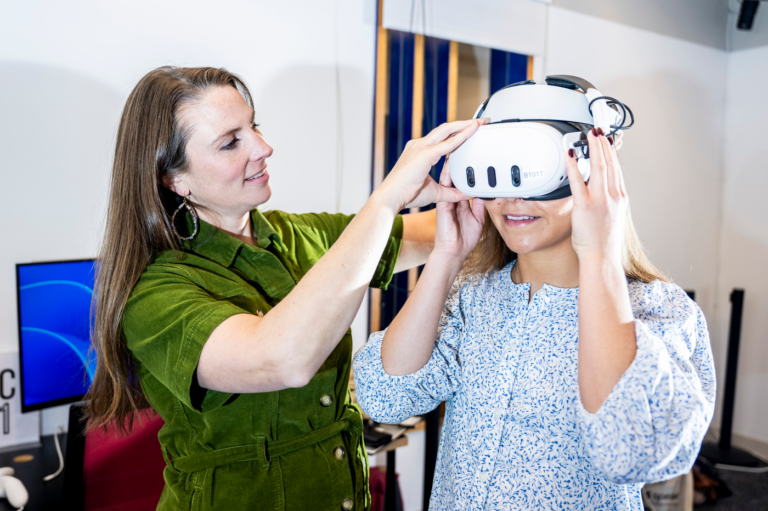
Eileen conducts design-based research on how people learn with immersive technologies like virtual reality (VR). In her work, she draws on learning sciences, educational psychology, and media studies to investigate the affordances and limitations of VR to situate learning in environments that are difficult or impossible in traditional classrooms. In particular, she is interested in the process of learning with VR and how the design of virtual environments and activities affect how learners use and experience them, and ultimately how that helps or hinders their learning. In her current work she is studying such processes related to learners’ sense of agency, emotions, self-beliefs, and identities, and how they are affected by design features like varied types of interactivity. Her work crosses many different populations and contexts, including university health profession students, high school STEM education, workforce development training, and game-based learning to teach problem-solving skills.
Eileen completed her Ph.D. in Education at Harvard University where she also served as an instructor and a researcher in Project Zero’s Next Level Lab and the NSF-funded EcoLearn projects. Prior to Harvard, Eileen researched technology and innovation in education systems around the globe at the Brookings Institution in Washington, D.C. and the Education Reform Initiative in Istanbul, Turkey. She holds an MA in Public Policy Analysis from Sabanci University and a BS in Media Studies from the University of Illinois Urbana-Champaign.
Research/Publications Highlights
McGivney, E. (2025). Interactivity and Identity Impact Learners’ Sense of Agency in Virtual Reality Field Trips. British Journal of Educational Technology. 56(1), 410-435 https://doi.org/10.1111/bjet.13513
McGivney, E., Forshaw, T., Medeiros, R., Sun, M., & Grotzer, T. (2023). Addressing emotions and beliefs for vulnerable jobseekers with virtual reality. Education and Information Technologies. https://doi.org/10.1007/s10639-023-11923-1
Kleinman, E., Jahani, R., McGivney, E., Cooper, S. & Harteveld, C. (2025). From Locked Rooms to Open Minds: Escape Room Best Practices to Enhance Reflection in Extended Reality Learning Environments. Proceedings of the ACM Conference on Human Factors in Computing Systems (CHI) 2025. 26 April – 1 May, 2025. Yokohama, Japan.
Zhu, T.*, Cheerman, H. Cheng, M., Kiami, S., Chukoskie, L., & McGivney, E. (2025). Designing VR Simulation System for Clinical Communication Training with LLMs-Based Embodied Conversational Agents. Extended Abstracts of the CHI Conference on Human Factors in Computing Systems (CHI EA ’25). Yokohama, Japan: CHI 2025. https://doi.org/10.1145/3706599.3719693
McGivney, E., Varma, M.*, & Pimentel, D. (2025). Work in Progress—The Impact of Guidance on Learning and Agency in a Virtual Reality Game for STEM Education. Proceedings of the 11th International Conference. Immersive Learning Research Network. [Anticipated Publication Fall 2025]
McGivney, E. (2024) Designing for playful learning in formal education: A case study of virtual reality field trips, in Gray, C., Ciliotta Chehade, E., Hekkert, P., Forlano, L., Ciuccarelli, P., Lloyd, P. (eds.), DRS2024: Boston, 23–28 June, Boston, USA. https://doi.org/10.21606/drs.2024.945
McGivney, E. (2024). Learners’ Presence in VR Field Trips Depends on Design of the Media, Not Novelty. In Lindgren, R., Asino, T. I., Kyza, E. A., Looi, C. K., Keifert, D. T., & Suárez, E. (Eds.), Proceedings of the 18th International Conference of the Learning Sciences – ICLS 2024 (pp. 67-74). Buffalo, USA: International Society of the Learning Sciences. https://doi.org/10.22318/icls2024.333889
McGivney, E., Queiroz, A. C. M., Miller, M. R., Liu, S., Beams, B., Han, E., Woolsey, E. S., Frazier, K., Petersen, X., Hancock, J., & Bailenson, J. (2025). Complexity of Agency in VR Learning Environments: Exploring Associations with Interactivity, Learning Outcomes, and Affect. In J. M. Krüger, D. Pedrosa, D. Beck, M.-L. Bourguet, A. Dengel, R. Ghannam, A. Miller, A. Peña-Rios, & J. Richter (Eds.), Immersive Learning Research Network (Vol. 2271, pp. 65–79). Springer Nature Switzerland. https://doi.org/10.1007/978-3-031-80475-5_5
Departments
Art + Design, Communication Studies
Education
- Ph.D., Education, Harvard University
- M.A., Public Policy Analysis, Sabanci University
- B.S., Media Studies, University of Illinois Urbana-Champaign
Research Focus
- Virtual Reality
- XR
- Education
- Learning Sciences
Courses Taught
- XR History, Theory, and Impact
- Communication and XR
- Mixed Research Methods for Games