


Departments In This Story
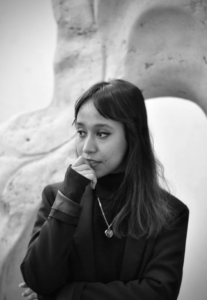
Sutanuka Jashu is a first-year Ph.D. student studying Interdisciplinary Media and Design at Northeastern as well as one of the Center for Transformative Media’s newest team members.
Jashu is an interdisciplinary artist, designer, and researcher whose work explores the intersection of artificial intelligence, cultural memory, and speculative spatial systems. Before beginning her Ph.D. at Northeastern, she was a visiting scholar at Harvard University’s CAMLab, a research center that combines humanistic inquiry with cutting-edge technology and design.
For this edition of the Scholar Spotlight series, CTM Communications Specialist Claire Ogden interviewed Jashu about the intersection between her research and art practice, her work on the Retro Mobile Gaming Project and more.
This interview has been edited for brevity and clarity.
Center for Transformative Media: How was your experience as a Harvard CAM Lab artist-in-residence? What did you learn there?
Sutanuka Jashu: My time at CAMLab was pivotal in shaping how I approach research through design. While I was there, I focused on how immersive and computational media can reinterpret cultural narratives, while also engaging in coursework at the Graduate School of Design and the Divinity School, which grounded my work in theory and critical spatial thinking.
That blend of conceptual exploration and technical rigor really expanded my understanding of how cultural heritage can be translated into contemporary media systems. I also had the opportunity to collaborate with students and researchers across the lab on experimental projects involving AI and narrative space.
That year helped me develop a methodological clarity that continues to influence my current work at Northeastern, especially in thinking about how technology, mobility, and culture can converge to create new forms of storytelling.
CTM: How is the Ph.D. going? What are some highlights so far?
SJ: The Ph.D. so far has been incredibly rewarding. My fall courses have really expanded how I think about human-centered AI, mobile communication, and creative media systems. But what’s most exciting is seeing how theory and practice can inform each other. I’m constantly discovering new ways to connect my background with emerging research in technology and culture.
At the same time, I’m leading The Retro Mobile Gaming Project (RMGP), which is Professor Adriana de Souza e Silva’s flagship initiative at the CTM.
RMGP explores the history of early mobile technologies and will reimagine them through AI-mediated archiving and interactive storytelling. So far, my work there has mostly included curating the collection, refining its framework, and shaping how the archive communicates the evolution of early mobile technologies.
I’m also working to grow it into a collaborative research platform that preserves digital heritage while engaging communities in rethinking how we interact with the memory of technology itself.
My vision is to expand the project into a collaborative research platform that uses storytelling and critical inquiry to explore how technological artifacts serve as tools for reflection revealing how even the most ordinary devices carry traces of human memory and cultural experience.
I am looking forward to seeing that vision take shape within the Ph.D. program. So far it has been both humbling and deeply motivating.
CTM: How would you describe your art practice and how it relates to your research?
SJ: My thesis was in architecture, so I’m trained naturally to be part of a research-based practice. For me, art installations are more of an end product or a representation of the research. But for me, the value of research behind the particular work is extremely important for me.
In my research for the thesis, it was on linguistic diversity in India and how Indian architecture kind of redevelops it.
The research is boring if you show it to normal people, because it’s huge, and there is just so much data. So I always try to translate it through artistic practice so it becomes an engaging and fun experience for the audience. It can also foster more serious conversations.
I think research and artistic practice, for me, is kind of an intersection of each other. Like, I cannot do an art project without deep research on it. It needs to have a meaning.
CTM: Are there any recent artistic projects that you’re proud of?
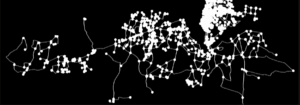
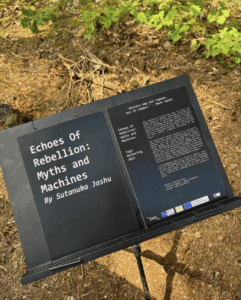
SJ: For the last year, I have been developing another project called ECOs of Rebellion, which is an intersection of AI on the historical data of Lithuania. So I was living in Lithuania for 2 months, and during that time, I developed this project according to a festival that they had. And last year, we had this project being exhibited at Arctic Psyche for the Cambridge Science Festival. So, that was very interesting. And Media Sculpt also went to New York. It was very busy, but so rewarding.

CTM: Awesome. And what is the impact of those projects?
SJ: So for Media Sculpt, which is about the linguistic diversity of India and how it affects the general ecosystem of people, I was trying to research how migration and also colonization of Indian cities have been affecting the languages, and how people shift during time. With the help of AI, I developed a system where we can predict the change of this language that has been happening throughout the centuries.
So I developed an interactive play zone where people can see the architecture as well as the language as they change each of the languages, and the architecture also kind of changes. So the viewer is prompted to ask themselves: what happens if this kind of language kind of evaporates? India has 43 official languages and more than 140 dialects. So what happens if some of the dialects evaporate, or become invisible, or expire, and we just lose the architecture of the whole city?
With the help of 3D software, we made this interactive device system that changes its form as you go and change your different languages. And if you lose some of the languages, this form gets deleted from the digital architecture.
CTM: What drew you to study this? And what does it mean to you to lose these languages?
SJ: When we made this predictive modeling, it was kind of an intervention, because at this point in India, we are heavily influenced by Western culture. And also within India, with the help of the political system and everything, we are kind of prioritizing one language over another.
And English has almost become like a major official language, or Hindi has become an official language, which I wanted to address, because I don’t speak Hindi. I speak Bengali. I had to learn to speak Hindi, so it’s kind of eye-opening when you show people what happens if tomorrow the Bengali language gets deleted from the whole city.
And language and culture in India is very interrelated. So, when you delete the language, people forget their own culture as well.
CTM: I love that. And how does AI play into your artistic practice?
SJ: It really varies from person to person, because for me, I use AI as more of a collaborator, let’s say, a co-author, a co-dreamer.
Nowadays, I think if you talk about this problem with agency and with privacy, I think it’s very important to understand how you want to use AI, and to what extent do you want to give this AI the permission to deal with your own ideas?
Because the moment you stop thinking about your own ideas and start, kind of depending on the results of an AI, you lose your own authenticity. Then it doesn’t make sense to call AI a collaborator anymore. It becomes: the AI made your work.
You need to keep in mind how you’re using it. For example, in a project that I’m working on right now, we use our own datasets to develop and train the AI. We make our own AI to develop a system that we want. So we are not using public data at this point to train this AI.
For us artists, this is a very important thing. To be very mindful of what kind of data set you are using, how are you using this practice-based research, what do you call this practice-based research? Are you ChatGPT-ing your installations, or are you asking AI how you can develop your own ideas further?
We have to be very, very mindful of how we are going to use these technologies to help human flourishing instead of AI flourishing.
CTM: I like that. So you’ve been in Boston for over a year now. What are your favorite artistic resources in the city? Or what kind of exhibitions or art pieces have you seen that have inspired you in your own work?
SJ: Boston is a fascinating city, so much to explore. But because my practice is always based on technical research, I was very fascinated when I visited MIT Media Lab and the MIT Museum, it was really transformative.
Even when I was in France, I didn’t have this exposure to really interact with the projects that have been happening, and I think I attended, like over 30 conferences throughout the city last year. Like, every day there was some art project going on, some kind of event, some kind of talk. It was absolutely transformative for me.
And I don’t know if you know about it, there is an organization called Antikythera. So, it researches planetary computation and the idea of philosophy in planetary computation and the use of technology and stuff.
And they had this two-day event at the Media Lab, which was super inspiring for me. So I was very lucky to be in the city to witness these extremely talented minds come together in the same room to talk about the problems and the development of these technologies, and what we can do as human beings to help the next generation flourish.
 CTM: Maybe as a final question, I think there are a lot of parallels between the history of the internet and the history of AI, but AI is so different in that it’s fundamentally a mediator. Like, when the internet first became a thing — not that I was old enough to use it then —it was so exciting because people could connect to each other directly, and it cut out the middleman. But AI is a middleman, so you’re introducing something that kind of comes in between people.
Is it possible for a technological middleman to enhance human connection?
SJ: That’s interesting, because I am a 90s kid. So I remember when you talk about the history of the internet.
It takes me back to the time when we had these huge computers, and there was this internet connection that would take two to five minutes with this sound, BSNL connection sound going on, like TDD and all those things.
So, during that time, at least, the internet was considered more like a network of networks, to connect people together, to give them more access.
Contrary to that, I remember, like, in 2021 when DALL-E’s first iteration was released, and we had these fascinating images where the machine is hallucinating. We didn’t really understand what was going on, but that was a time when you realized that technology is taking a turn as a mediator.
I think both the history of the internet and AI is kind of right in its own time, because the internet is more about access, and AI becomes more like a simulation mediator, a middle person, which uses you as a data set, let’s say.
CTM: Your background is in architecture, right?
SJ: Actually, my bachelor’s degree was in animation, but by the end of undergrad, I was more fascinated with the idea of architecture, because I had a friend whose father was an architect. So I started to join him for the next six months and didn’t leave for the next six years. And I was there in architecture studios. I liked the idea of designing your own exhibits, interiors, and commercial spaces.
And to have them develop into a practical thing. So I like this real-time generation of ideas, but at the same time, I also was very much interested in software and generative design. So I think during the pandemic was the time when I started to diverge from architecture to more conceptual and experimental work. That is when I came across artistic practice.
But it’s very new. I’m still trying to figure myself out and see where I can take it.
CTM: Yeah, I mean, that’s what a PhD is for, right?
SJ: Exactly.
Related News

CAMD faculty present results of Creative Catalyst Program
August 20, 2026

New Faculty Joining CAMD
August 5, 2026

Ilya Vidrin wins major grant for embodied ethics research
August 5, 2026