

Carmen Hull
 Carmen Hull, Assistant Professor with a joint appointment in Art + Design and Architecture, works in the field of data visualization, an academic discipline that interprets complex data sets and translates them into visual forms that offer new insights and understanding. Hull, informed by her background in architecture and fine arts, specializes in data physicalization, an area of data visualization that introduces physicality into the presentation of data, creating structures, sculptures, and other tangible objects to activate and engage audiences.
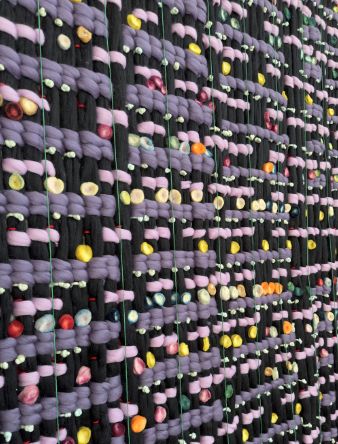
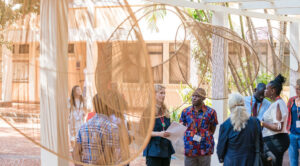
Her most recent project is Rap Tapestry, an 8-foot by 8-foot weaved tapestry that represents the lyrics and rhythm of 1993 hip-hop hit 93 ’til Infinity by Souls of Mischief. The project, profiled in the Boston Globe, is only the most recent of Hull’s creations. Another is Rule of Thumb, a large-scale bamboo installation resulting from a parametric design process that incorporates statistics from the World Economic Forum’s Global Gender Gap Report. This work was displayed at the UNEA-7, a United Nations Environmental Assembly panel in Nairobi, Kenya last year. Another installation, The Secret Life of Sneakers, utilized data from partner organization The Footwear Collective to depict waste in the sneaker life cycle and advocate for more sustainable practices.
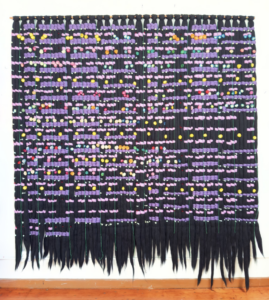
What these projects have in common is the translation of raw data into tangible forms that can be seen, touched, and experienced. “Tangible interaction lends a layer of engagement and memorability,” says Hull, “but also communicates another layer of information beyond what we can capture with data itself. Data is always translated through a frame of meaning – someone chooses a definition of parameters of what is important. By introducing material aspects, you bring another layer of richness to the data.”
The genesis of Rap Tapestry was a conversation between Hull and her friend Tajai Massey, an architect and rapper in the group Souls of Mischief, an underground hip hop group based in Oakland. While listening to the way Massey spoke about his process, Hull started thinking about how his work could be represented visually. “By listening to the way experts talk about their own work, we can connect to the mental models underneath a visualization,” she explains. Hull applied for and received a CAMD seed grant to launch the project, and she identified several student researchers who joined the project and contributed in the areas of design and audio transcription.
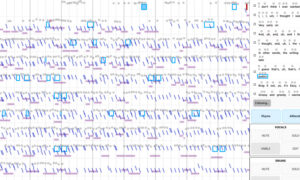
In rap music, the critical relationship between beats and rhymes creates a flow metric that musical notation doesn’t capture. Hull envisioned a representation that would incorporate the flow metric and also account for Massey’s description of density of rhyme. Her intent was to capture the qualities and elements of rap music that the masters of the genre identify as being essential. She worked with Massey to digitally categorize and track the essential elements within 93 ’til Infinity and then generated a computer visualization that would guide the creation of a physical tapestry.
As with her Rule of Thumb project, which incorporated bamboo and bamboo artisans from East Africa, Hull wanted Rap Tapestry to contain localized elements. She collaborated with a weaver in Oakland to create the tapestry itself, using a hand-built loom and thick rows of wool. The colors, textures, and techniques used convey the warm, poppy qualities of the music. Hull says it was challenging to express high fidelity data in a low fidelity medium. “There’s a tension between data and physical material.” But she discovered that a woven tapestry was able to capture the essential features of rap effectively across the span of a complete song. In contrast, audio software could show just a time-based spectrograph.
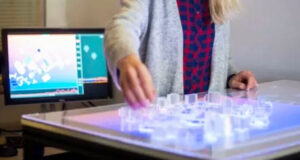
Hull has more projects in the works. She is designing digital platforms with the United Nations and several public policy groups. She is collaborating with Boston and New York schools to introduce her Rap Tapestry software to students. This academic year, she will be working with the Albert Holland School of Technology in Dorchester to pilot a curriculum that teaches students to create visual encodings that capture rap lyrics, beats, and sounds. “The digital tool we hope encourages people to analyze this particular genre in a deeper way,” she says.
Another exciting initiative is Hull’s work with the Northeastern University Plastics Center, an academic enterprise seeking to understand and mitigate harms caused by plastics through research, education, and policy engagement. Hull and her collaborators, including Professor of Public Policy Maria Ivanova, are planning a public art installation that visualizes plastics data through glitter – small pieces of plastic – communicating serious information about sustainability through a medium typically associated with fun and entertainment. “It’s almost like searching for enchantment again,” Hull says. “Usually this is in contrast to serious policy work and there is a tension between these. We’re not understanding where all the responsibilities lie. Government and policy have to make changes. We want to use glitter to engage people with where the issues are.” As with all her projects, there will be both a physical representation and a digital piece. “You need the granular data, but you also need to see how our lives connect to this infrastructure and the impact it has on us at an emotional level to enact change. Glitter is a way to take back the ownership on a citizen level, but not in the usual way. We don’t have to deny our emotional response, and we don’t have to deny our reasoning.”
Since creating Rap Tapestry, Hull has a much better ear. She can more readily detect the shifts and patterns that make for great hip hop. The visualization modality, she says, facilitates the development of new skills. Representing data in physical, tangible ways that tap into emotion enhances the process. “We need to use all of our intelligences – our entire brains, not just our analytical brains – to think about data.”
Rap Tapestry is on display at the Center for Transformative Media inside Northeastern’s Snell Library. To learn more about Hull’s work, visit https://www.carmenhull.com/.
Related News

Meet Hillary Chute: Unlocking the Power of Graphic Narrative
October 2, 2026

CTM Scholar Spotlight: Dana Bullister
October 2, 2026
Using theater and psychology to support Bay Area homeless youth
October 2, 2026