

People In This Story

Departments In This Story
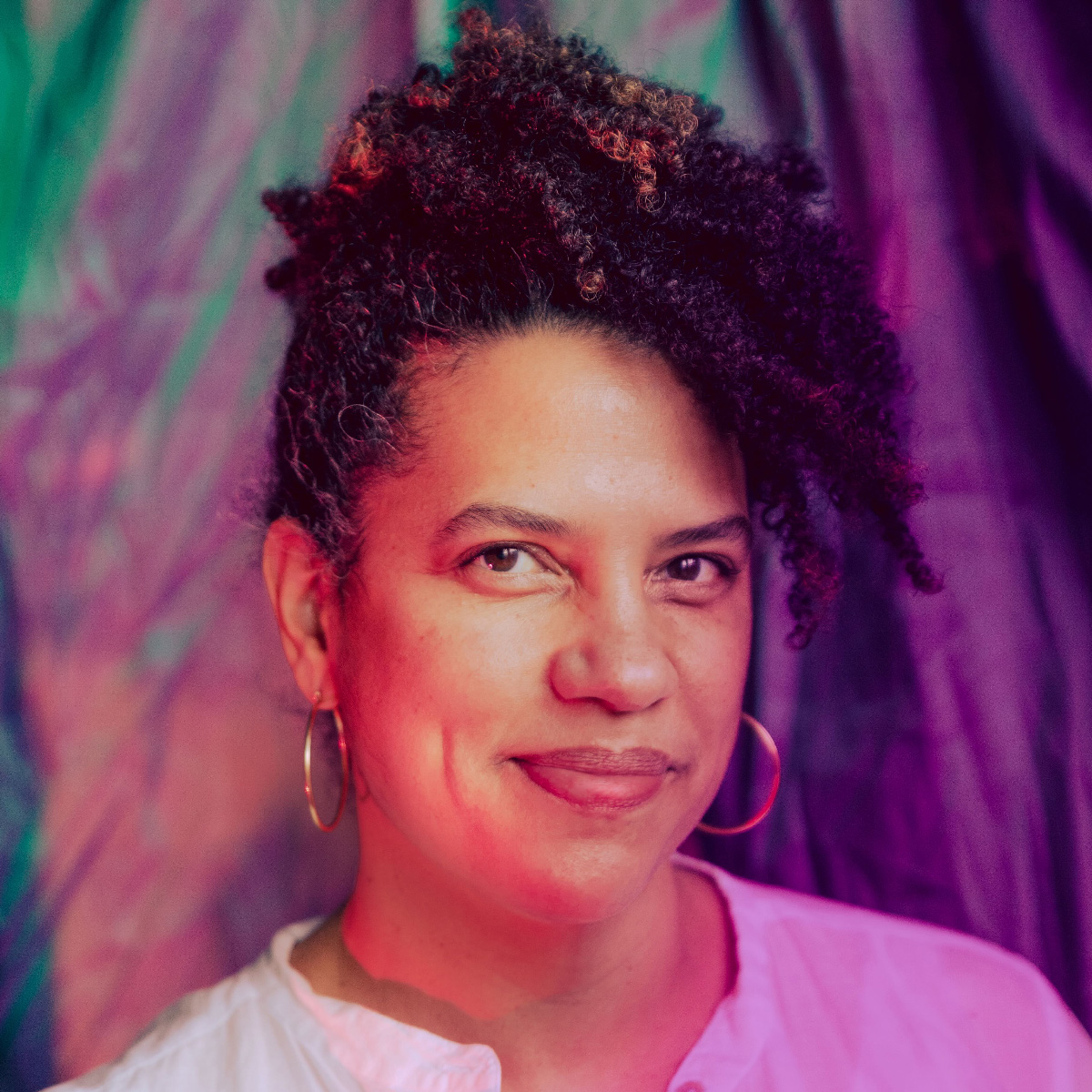
Jonathan Carr is a director, member of the Northeastern University faculty, and affiliate member of the Center for the Arts. This fall, he is directing the Department of Theatre’s production of Fun Home. In addition to his directing work, Carr is a proud member of the Data Theatre Collaborative, where he directs productions that translate data into theatrical language to empower community partners.
Jonathan holds an MFA in Directing from Columbia University and a BA in Theatre and Dance from Amherst College, and he has trained with Anne Bogart, Robert Woodruff, Andrei Serban, Kristin Linklater, and Vjacheslav Dolgachev, among others. He has directed in professional and academic settings across the Northeast, including Boston, New York, and Philadelphia, and previously taught at Villanova University.
The following interview has been edited for brevity and clarity.

Interview
CFA: Your bio says, “Jonathan loves plays that push the audience into dark terrain while also making them laugh.” Looking at your production history, that makes a lot of sense with Mayhem, Company, and many more. Can you share a little bit about what draws you to these types of productions?
Carr: Well, my origin story has me in a lot of comedies. As an actor and early director, I was trying to do things that were funny because that was my world. You get a response, you recognize it, and it’s immediate and thrilling. I was also aware of the cultural impact of inappropriate jokes, jokes at people’s expense, where the teller is at fault. However, I started to see that laughter makes us complicit, and that theatre has the power, maybe the responsibility, to show us uncomfortable truths. It can lead us into corridors of self-exploration we might not go down on our own, that we might resist without being led there.
So I got really interested in bringing an audience somewhere uncomfortable and putting them in a situation where they feel like they’re having a good time and laughing, and only later think, “Wait, what did it mean that I was laughing? What’s my responsibility in the situation? What’s my complicity?” It’s so easy for us to look outside, find fault in others, and blame the other team. It’s been true for a long time; it’s certainly true now. I find it pretty thrilling that we might go home singing a different song than the one we heard in the theatre, because it settles with us over time.
CFA: Your upcoming production aligns with this tone. This fall you’re directing the musical Fun Home, based on cartoonist Alison Bechdel’s graphic memoir. Can you share a little bit about this production and what you’re anticipating for this show?
Carr: Fun Home is more overt about going into dark terrain. The name sounds fun, but if you do a little research, it means “fun home,” as in a funeral home. Right at the beginning of the show, the Alison Bechdel character tells us it surrounds a moment right after she came out, when she learned that her father was gay, and then within a few months, he had died by stepping in front of a truck.
The show details Alison’s life at three different stages: as a young child of around ten, at the moment of coming out as a college freshman, and as an adult cartoonist at the same age as her father when he died, going through this archival moment as she creates the graphic memoir that made her name. This production is a musical adaptation of that graphic memoir.
Fun Home creates uncomfortable juxtapositions: light against dark, hope against tragedy, and beautiful songs against characters living through challenges that crush them. In a way, it mimics the structure of comics. There’s a world in this box, and a world in the box right next to it, and we create meaning by seeing them juxtaposed, by how we montage them in our brains. That same thing is happening on stage; it’s not a straight narrative.
I think the audience experience is going to be all over the map. There are going to be moments where we’re really mad at the father, frustrated with his inability to communicate, his inability to live his truth without hurting his wife and the family around him. We’ll find ourselves in love with Alison at different stages of her life, feeling for her, hoping for her, and knowing it leads to her father’s death, but also to her living a full life as a really productive and amazing artist. It has all the flavors in between: there’s silly stuff, there’s dark stuff, and I hate to say it, but in the end, it makes me cry, as a dad, as a theatre maker, and as someone who loves people.
CFA: In addition to your personal directorial practice, you’re a member of the Data Theatre Collaborative. Can you share a little bit about The Data Theatre Collaborative and how you originally got involved?
Carr: My wonderful colleague Dani Snyder-Young came to me and the Theatre Department with an idea about exploring what she called research-based theatre. The structure was to find university experts in various fields and offer them theatre as an additional communication technology, one that could reach audiences in ways their journal articles and conference talks could not. The data came from casting around for potential playmates, folks who would get into our sandbox and play with us. We found colleagues already interested in using theatre as a strategy, mostly through hands-on participatory workshops, to increase data literacy, and specifically to use theatrical techniques to break down barriers to entry for some folks in data-rich presentations.
Some people don’t get much out of spreadsheets or PowerPoints, the typical modes of communication at town meetings or planning sessions where something really important to them might be discussed. They may be excluded because they don’t speak the language of data, or because they find it off-putting or exclusive. We’ve been using theatrical tools to break down some of those barriers and bring people in more, especially marginalized voices.
We looked for a topic and a community organization to partner with to experiment with these techniques. We first worked with LivableStreets on a project about potential improvements to Southwest Corridor Park, which is great for us because our campus sits on part of that. LivableStreets had been doing surveys, and we started exploring delivering one in theatrical form. We invited an audience to come and watch and be asked questions live in the midst of explorations of some data. Might they feel more engaged, more easily included, more effectively heard?
After completing a proof of concept with LivableStreets, we moved on to the City of Boston’s Office of the Environment to help assess Boston’s 2030 Climate Action Plan. Over a semester, through workshops and data investigations, we created the devised production The Numbers. With the cast, I investigated the role that data plays in our day to day lives, and questions about our interactions with data inspired short personal pieces that punctuated the evening. But the main event of The Numbers was essentially delivered the city’s survey to the audience. Moment by moment, we delved into the topic a survey question addressed, demonstrated it theatrically, and then broke into the play to say, “Hey, audience, what do you think?” Sometimes we asked them to answer just by raising their hands or clapping, and sometimes they spoke directly with a cast member. Then, the production took that information straight from the audience and mirrored it back.
CFA: What is your experience like directing productions about data? How do you visualize and present this data in a three-dimensional space when we so often see it in two-dimensional graphs?
Carr: I’m really interested in form, and I lean heavily on a technique called Viewpoints, a form of improvisational ensemble movement training I studied with Anne Bogart, who articulated it for theatre and mentored me. I teach Viewpoints here at Northeastern, and I trained the cast of The Numbers in the technique. What Viewpoints allows us to do is create dynamic staging really quickly, in a way that’s not top-down. It comes from the cast improvising together, and almost everything they do is pretty interesting. That’s a reversal of the standard process in which a director tells people where to move and tries to build something that works. Here, a group creates its own dynamic staging, and the director can choose from those options.
At the very beginning of this process, we did a workshop in Viewpoints asking, “Can it be interesting at all to stage numbers? What if we do it without a playwright and without characters? What if we stage a graph?” It sounds deadly. Theatre people are not clamoring for this job. However, we discovered almost immediately that when you and I stand on stage as a data point, we bring our humanity with us. Though I don’t have much empathy for a data point on a line graph, I do when you’re standing there, because your body tells a story. Kind of against my will, even if I tell myself very rationally that I’m looking at a chart, I have my empathy engaged.
We saw this in The Numbers, where we mirrored the audience’s responses back to them. Depending on how the audience voted, we’d stand in different places– the cast would group themselves in a way that proportionately represented the audience’s opinion. In a way, it’s the theatrical equivalent of very active listening. Each performance was followed by a talkback. What was surprising and rewarding was how meaningful and emotional it seemed for people to dig into these kinds of stories, even though there was no plot, no characters to relate to, no inciting event or climactic moment.
We also learned that if we weave pure data moments, maybe just explaining a graph, with moments where people tell their story, it has a really powerful effect, particularly if the content of those things overlaps. That was especially true of our second production, Los Bocados, which was about food justice. We partnered with community organizations that work on food justice, among other things, and people from these communities where food insecurity is rampant spoke about what food means in their home culture, how insecurity plays out, and what their challenges are. Blending real people and their real narratives with what the numbers say, and then having people represent those numbers again, really knocked me over. As the person who started this thing by saying I was content agnostic, I recognize that I’m eager for a story I can care about and characters that mean something to me. I never expected to find that in my graph. My colleague Rahul Bhargava told us, and I didn’t really believe him, “People really love a map.” But it’s true. We put a map on stage, and suddenly audiences can see not just the people, but where they are and how they’re organized in space. In The Numbers, we mapped Boston. In Los Bocados, we mapped a Stop & Shop. Audiences just react to it. They get it.
CFA: Los Bocados wasn’t produced in a traditional theatrical space. You performed it at three drastically different public locations already connected to the community that the data represented. What was it like staging these productions?
Carr: For Los Bocados, a separate group was involved. One of the community groups, Hyde Square Task Force in Jamaica Plain, has a youth theatre group in both an after-school program and a summer program. Josephine Ross, their teacher and a doctoral candidate here, joined us, and we co-created the piece. Once we settled on a topic they cared about, the theatre group joined us, and Ross and I collaborated on which parts each mini-ensemble would originate.
Early on, we discovered that we wanted to avoid the trap of trying to represent stories our bodies couldn’t tell. It’s really fraught to speak from the perspective of someone from a community we don’t belong to, because putting our bodies on stage is already such a strong signifier. We’re comfortable saying the numbers are this and they change like that, but we won’t speak as a character whose story we can’t honorably represent.
So the Northeastern troupe focused on generating the data-rich pieces, and the Hyde Square Task Force actors created the personal reflections: stories about meals in their homes, a story about a father who was always working and didn’t get to eat with his family, a story about a girl making recipes that her grandmother showed her. Not always serious. Some light and some funny, a really nice cross-section of life in the community. It was nice to lean on the authentic voices of people living the life that the data is about.
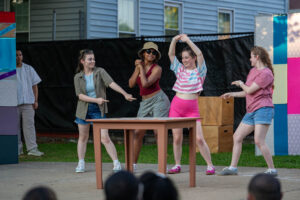
The Mellon Foundation grant we received had multiple stages: stage one, do a show in our house; stage two, take it out to them. We’ve run participatory workshops with different groups, building connection and furthering the work Rahul, Laura Perovich, and others have been doing, using data as a tool to increase literacy and connect. Those groups include Hyde Square Task Force and La Colaborativa in Chelsea, and we spent so much time building connections with them that it felt natural to bring our performance to them. We settled on performing at Northeastern, right next to Centennial Quad, in Mozart Park in Jamaica Plain, and at La Colaborativa.
The latter two are places where food justice and food insecurity are really pressing issues. La Colaborativa runs an enormous food distribution multiple times a week, and it was incredibly powerful to think about telling these stories about food insecurity where the community comes to be fed. We also knew we wanted to engage the community in conversation and then feed them. We always brought in food, so the production nourished us on multiple levels, and the conversations kept going as the community mixed around these stories and a good meal. That feels like really honorable work that we’re proud to do.
CFA: Lastly, what are you most excited about exploring in the future of your practice?
Carr: I’m really interested in empowering actors, and our students, to create rich, dynamic theatre that is more than they think it can be. Our world is in such crisis. What place can theatre have in that conversation that brings us to a different spot? I don’t really care what Hamlet meant in 1600. I’m really interested in what it could mean now. We need to understand what the impact was to have a sense of what it could be, but the question is what it means here for us, in our world, in this space.
I’m really excited to make Fun Home the way we’re making it, with a cast of college students. Even though the cast runs from 40-year-olds down to six-year-olds, we are making it as a group of young artists investigating big questions about identity, what they inherit, and how they carve out a life for themselves. So we can tell Alison Bechdel’s story, delight and upset the audience in the most important ways, and also ask these really big questions that touch us right now.
I’m also really hoping there is a phase of the Data Theatre Collaborative where we engage a totally different community. Right now, my eyes are on elders. Collaborating with groups in senior care settings, amplifying those incredibly important voices, and exploring their perspectives feels like an exciting new frontier for me, among many others.
Closing
Fun Home, directed by Jonathan Carr and presented by Northeastern University’s Department of Theatre, will be presented November 18-22, 2026. The Center for the Arts is sponsoring a post-performance talk with Hillary Chute on Saturday, November 21st, after the 7:30 pm performance. More information about the program is available here, and more information about the Department of Theatre’s productions is available here.
Related News
PhD student Paula Martin Rivero will exhibit work at IEEE VISAP
October 29, 2026

Jiabao Li has a banner year of exhibitions
October 29, 2026

Paolo Ciuccarelli defines metadesign
October 29, 2026